A ceramic tile grade can create procurement risk when its meaning, test evidence, sample, or intended application is unclear. Buyers should identify the classification system and product scope, verify the characteristics that matter to the project, inspect appearance and batch variation, and confirm installation requirements with qualified reviewers. A risk-based comparison focuses on mismatches that could affect safety, performance, schedule, cost, or the finished space.
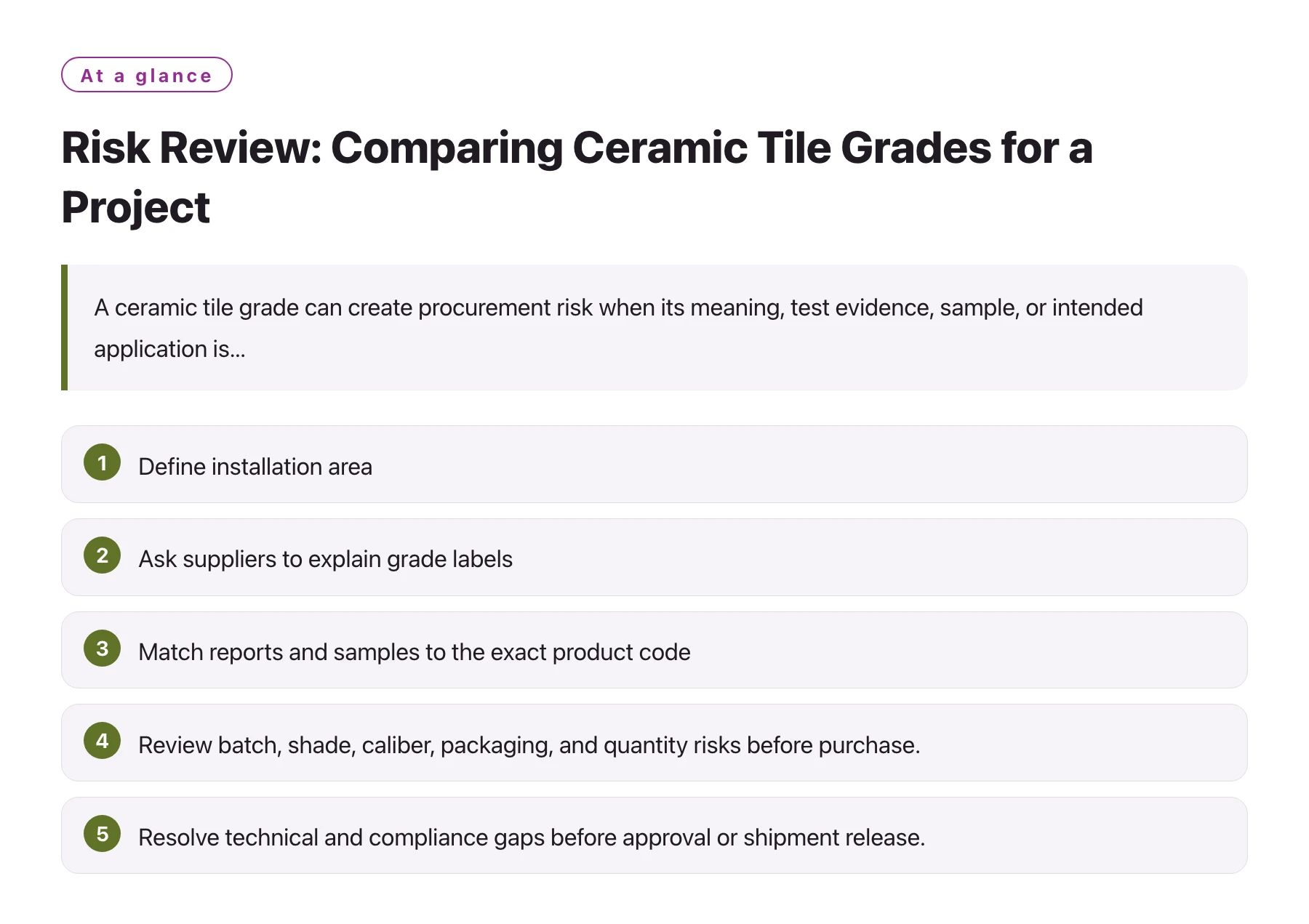
Key takeawaysDefine installation area, exposure, substrate, traffic, finish, and project market. · Ask suppliers to explain grade labels, standard scope, declared characteristics, and exclusions. · Match reports and samples to the exact product code, size, finish, and production source. · Review batch, shade, caliber, packaging, and quantity risks before purchase. · Resolve technical and compliance gaps before approval or shipment release.
Use a grade comparison to expose unresolved product and evidence risks, not to substitute for a project professional’s selection.
Risk 1: Comparing labels that mean different things
A supplier’s “premium,” “first quality,” “porcelain,” or “commercial grade” wording may not use the same classification basis as another supplier. Ask which standard, edition, product scope, classification, and marking rules support each term. Record the exact product code and intended application so a marketing label does not become the only comparison point.
ISO 13006:2018 defines terms and classifications and establishes characteristics and marking requirements for ceramic tiles within its stated scope; ISO 10545 covers test procedures for the listed characteristics. The standard has scope and process exclusions, so confirm applicability to the offered product and current project requirements with a qualified reviewer. [1]
Buyers working with Shanghai JS Sourcing can request suppliers to list each declared property and its evidence rather than using one summary grade. Ask them to identify which characteristics are tested, declared, not tested, or outside the document’s scope.
Risk 2: Selecting a classification that does not fit the use
The project application determines which properties matter. Interior wall, floor, wet-area, exterior, high-traffic, and specialty uses can present different requirements. Confirm substrate, installation method, exposure, cleaning, and destination market with the designer, architect, engineer, or compliance owner. A general tile classification does not automatically show suitability for every site condition.
List mandatory characteristics and acceptance criteria before asking suppliers to compare offers. Depending on the design, these may include dimensions, water absorption, breaking strength, surface quality, abrasion, slip-related characteristics, chemical resistance, or frost-related performance. Do not add tests as a generic checklist; let the technical owner select relevant properties and methods.
If the product will be installed in a regulated or high-consequence area, obtain professional review before approving a supplier claim. Keep code or market obligations separate from aesthetic preferences. A tile can have an attractive finish yet remain unsuitable for the specified application or installation system.
Risk 3: Applying a report to the wrong product
A test report should identify the manufacturer, product code, size, thickness, finish, sample description, test method, results, date, and limitations. Compare those details with the quotation and approved sample. A report for a similar tile or product family may not support another size, finish, manufacturing process, or accessory.
Check who selected the sample and whether it represents current production. Ask whether the test method and reported value correspond to the characteristic in the specification. If a document is summarized or translated, review the underlying file or obtain a verified explanation from the issuing organization. Keep the document linked to the specific supplier, site, and configuration.
Resolve conflicts between documents before purchase. If a declaration shows one value and a test report another, ask the technical owner to interpret the scope and applicability. Do not average the values or assume that the higher result is the correct one. Record the accepted basis in the product specification.
Risk 4: Mistaking a sample for a production guarantee
A sample can help review color, pattern, texture, gloss, edge, dimensions, and visible defects, but it represents a particular specimen. It does not establish consistency across production, the quality of every lot, or the condition after transport and storage. Record supplier, product code, batch if known, date, finish, dimensions, and approval scope.
Compare several pieces under consistent lighting and against the project’s finish references. Look at surface variation, print repeat, warpage, edge condition, and the relationship among trims or accessories. For a large field, review a mockup or arranged set when the designer needs to judge overall pattern and grout appearance. A single chip or tile can hide range and repeat effects.
Tie sample approval to the quotation and purchase order. If a revised sample is submitted, identify the change and whether it affects classification, test evidence, packaging, or installation. Keep the accepted reference until production and receiving are complete.
Risk 5: Batch variation, shade, and caliber
Tile production may involve coded shade or caliber information that buyers and installers need to manage. Ask how cartons identify batch, shade, size, and quantity and whether the project can reserve sufficient stock from the same production run. Confirm how replacement cartons will be sourced if the order is phased or a later repair is expected.
Map quantities to room or area and coordinate batches with the installer. Decide whether lots can be mixed and how visible transitions will be managed. If the supplier cannot guarantee future matching, plan reserve stock and storage before placing the order. Keep reserve cartons labeled and protected from moisture and damage.
At receiving, check carton marks, counts, visible breakage, moisture, and sample appearance before distributing goods. Record the affected lots and photographs. If different shades or calibers are mixed, hold the material until the installer and project owner determine the right disposition.
Risk 6: Quantity, packaging, and installation mismatch
Normalize quotations for product code, unit of measure, carton coverage, pieces per carton, pallet count, trims, accessories, and delivery point. Confirm whether price is per piece, square meter, carton, or another unit and how partial quantities are handled. A conversion error can lead to shortages or excess that disrupts a project budget and sequence.
Specify edge protection, face separators, carton strength, palletization, labels, and handling based on fragility and route. Compare package dimensions and weight with transport and receiving limits. A damaged pallet can affect both material availability and the project’s installation plan. Ask for a packed sample or photographs where protection and identification are important.
Check installation tolerances, substrate preparation, joint assumptions, grout, movement joints, and transitions with the responsible designer and installer. Procurement should not decide these details from a supplier catalogue. Record technical assumptions that affect the selected tile and communicate them to the site team.
Risk 7: Unclear destination and documentation obligations
Identify the market and project location before asking for certificates or marks. Requirements can depend on jurisdiction, product scope, intended use, and date. Ask a qualified compliance owner to determine which declarations, language, labels, and technical records are needed. A document accepted for one country or customer is not automatically sufficient elsewhere.
Verify issuing organization, certificate status, site, product scope, dates, and annexes. Look for mismatched manufacturer names, model numbers, or missing schedules. These inconsistencies require clarification; they do not alone prove a document is invalid. Contact the issuer or request a complete copy when the document affects a material decision.
Set a document register with requirement, source, product, reviewer, status, and open question. Keep current and superseded versions separate. If a report or declaration is pending, identify whether the order, payment, shipment, or installation must wait for review.
Risk 8: Supplier substitutions and project changes
Define who may approve alternatives and which changes require a new sample or report. Changes to body material, thickness, finish, size, process, factory, test method, or packaging may affect accepted requirements. Require a written change request with reason, cost, timing, evidence, and impact on design or installation.
Track project revisions as room quantities and layouts change. Map each revised drawing to affected product tags, quotations, purchase orders, and delivery phases. If one phase uses a different tile batch or finish, label the distinction and obtain design approval. A general purchase order update may not reach each supplier or factory line unless the change path is explicit.
Do not authorize shipment while a material change or technical deviation remains unresolved. Record acceptance, rejection, rework, replacement, or hold by product and lot. This makes the disposition traceable and prevents a sales or schedule discussion from being mistaken for technical approval.
Use a risk matrix before selection
Create a matrix with requirement, supplier claim, supporting evidence, sample result, exposure if wrong, likelihood, mitigation, owner, and status. Use the project’s risk method rather than inventing precise scores. Highlight mandatory requirements and open questions so a low price cannot hide a critical evidence gap.
Set gates for technical review, sample approval, commercial acceptance, inspection, and shipment release. At each gate, state which documents or decisions are needed and who can authorize progression. A gate should not imply that one person’s approval covers design, compliance, quality, and financial decisions beyond their scope.
After delivery, compare actual results with the risk assumptions. Record damage, breakage, shortage, shade variation, document mismatch, schedule, and installation issues. Use project evidence to adjust future criteria while keeping observations specific to the product, batch, site, and known handling conditions.
Sources
Frequently asked questions
Does a higher tile grade always mean a better project choice?
No. Compare the classification basis with the actual application, design, destination market, installation, budget, required characteristics, and available evidence; confirm project requirements with the responsible technical reviewer.
What should I check on a ceramic tile test report?
Match product identity, size, finish, sample, test method, results, date, issuing organization, and limitations to the exact quotation and project need.
Can one sample represent the whole order?
It can support review of one specimen. Use batch identification, production controls, inspection, and receiving checks to manage variation across the order.
When should tile shipment approval be withheld?
Hold affected lots when required evidence, sample approval, batch identity, inspection disposition, or a change decision could alter acceptance for the project.