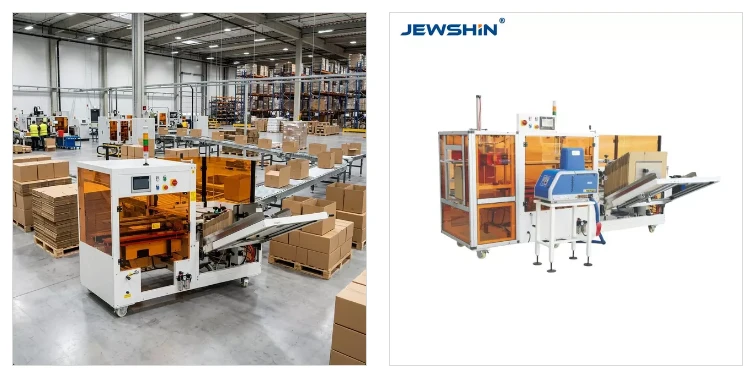
Custom-engineered automatic packaging machines fit production lines where product size, shape, material, speed, or pack format falls outside standard equipment ranges. A line running 60 packs per minute for two 8-hour shifts handles 57,600 packs per day; even a 1% reject rate affects 576 packs. Engineering the feeder, conveyor, sealing system, controls, inspection stations, and changeover parts around real products can reduce misfeeds and manual adjustments. The useful measure is stable output of saleable packs, not the machine’s maximum advertised speed. For multi-SKU plants, custom engineering also allows recipes, servo adjustments, vision inspection, and an automatic carton erector to operate as one coordinated packaging line.
Standard packaging equipment works well when products stay inside a predictable range of dimensions, weight, orientation, and packaging material. Problems start when one production line handles fragile items, irregular shapes, several carton sizes, or products whose dimensions vary by 5–10%. A machine designed around one fixed product envelope may require guides, spacers, additional operators, or repeated manual adjustments. Those additions affect usable production time, so equipment selection has to start with the product rather than catalog speed.
Product data gives engineers the first useful boundary. Instead of designing around one nominal sample, an engineering review can measure 30–100 samples across different production batches and record maximum and minimum length, width, height, mass, surface condition, and center-of-gravity differences. If a nominally 200 mm product actually ranges from 196 to 204 mm, a guide system designed for exactly 200 mm can create unnecessary contact or poor positioning.
A machine that runs one perfect sample at 100 packs per minute has not demonstrated that it can run a full production batch at the same rate.
That variation leads directly to feeding and handling. At 80 products per minute, the machine receives one item every 0.75 seconds. A feeding system therefore has less than a second to separate, orient, space, and present each product correctly before the next one arrives. Servo-controlled belts, indexing conveyors, custom guide rails, vacuum pick systems, or robotic handling can be selected according to actual product behavior rather than fitted afterward.
Contact with the product also needs measurement. A rigid metal component can tolerate handling that would mark a coated cosmetic item or deform a soft bakery product. If a line processes 25,000 units per shift and handling damage falls from 1.2% to 0.4%, the difference is 200 saleable units per shift. Over 250 production days, that represents 50,000 units that no longer enter scrap or rework.
Handling improvements matter only when the next packaging operation can accept products at the same rate. A machine rated for 100 packs per minute theoretically produces 48,000 packs during an 8-hour shift, but 85% availability reduces the operating equivalent to 40,800 before quality losses are counted. Three 10-minute stoppages remove another 3,000 theoretical machine cycles at that rated speed.
Rated speed and sustained output should therefore be treated as separate numbers. Factory acceptance testing can record total test duration, accepted packs, rejects, stops, and stop causes instead of relying on a short maximum-speed demonstration. A 4-hour run using normal packaging material and production samples provides more useful information than several minutes with carefully selected products.
Once sustained output is measured, changeover time becomes easier to price. A plant producing five SKUs may change format three times per shift. At 35 minutes per changeover, 105 minutes of an 8-hour shift are unavailable for normal production. Cutting each changeover to 12 minutes returns 69 minutes, equal to roughly 4,140 additional machine cycles on a 60-pack-per-minute line before other efficiency losses.
Custom engineering can shorten those changes through recipe-controlled servo positions, numbered mechanical settings, quick-release format parts, fixed locating pins, and tool-free guides. A stored recipe can recall conveyor speeds, timing offsets, seal temperatures, inspection tolerances, and product spacing. Mechanical parts that still require replacement can be designed so operators install them in only one valid orientation.
| Production issue | Example operating condition | Engineering response |
|---|---|---|
| Product size variation | ±4 mm | Adjustable or servo-positioned guides |
| Frequent SKU changes | 3 per shift | Stored recipes and quick-change parts |
| High line rate | 80 packs/min | Synchronized product spacing |
| Fragile surfaces | 1% damage target or lower | Controlled transfers and low-contact handling |
| Multiple carton sizes | 5–10 formats | Adjustable carton handling |
| Quality inspection | 100% of packs | Vision, sensors, checkweighing or code verification |
Format flexibility then affects secondary packaging. A product may leave the primary wrapper correctly but still encounter delays if cartons are erected manually or supplied inconsistently. An automatic carton erector can form and present cartons at a controlled rate so downstream loading equipment receives a repeatable container. On a line using 20 cartons per minute, one 8-hour shift requires up to 9,600 cartons before planned stops are considered.
Carton handling has its own tolerances. Corrugated board can change with supplier, storage humidity, score quality, and manufacturing lot, while carton dimensions may vary slightly from nominal specifications. A custom system can use adjustable magazine guides, controlled vacuum pickup, carton-presence sensors, and programmable timing. Testing should include more than one carton batch because a 2026 production run may not behave exactly like the samples used during machine design.
Packaging material behavior deserves the same attention. Films and laminates respond differently to heat, pressure, tension, and dwell time. A seal that performs well at 30 packs per minute may become less consistent at 70 packs per minute because available contact time falls. Paper-based packaging may introduce different friction and stiffness from conventional plastic film, requiring changes to forming geometry and material control.
Material qualification should use the intended production material, normal supplier tolerances, and the required operating speed rather than a single ideal roll.
Quality inspection follows naturally because faster automation increases the number of products affected before an operator notices a recurring fault. At 90 packs per minute, five minutes of undetected incorrect labeling can involve 450 packages. Vision systems can inspect label presence, orientation, printed codes, package position, or selected dimensional features on every pack, while sensors can confirm product and carton presence before a cycle continues.
Inspection needs a defined response rather than a simple pass/fail signal. A rejected package can be diverted automatically while its fault category is recorded by the PLC or line-control system. If 18,000 packages are produced and 144 are rejected, the reject rate is 0.8%; separating 90 seal faults from 54 positioning faults gives maintenance staff more useful information than one combined reject counter.
Machine controls also affect recovery after a stop. Operators should be able to see where the stop occurred, which sensor changed state, and which section is waiting for another machine. A line with 15 short stops of two minutes each loses 30 minutes per shift; reducing average recovery from two minutes to one saves 15 minutes without increasing mechanical speed.
That approach becomes more important when several machines share one line. A wrapper, labeler, checkweigher, case packer, and palletizer may each have enough individual capacity, yet poor communication between them can still cause stops. Custom controls can exchange ready, running, blocked, starved, and fault states so upstream equipment slows or pauses before products accumulate at a stopped downstream station.
Accumulation capacity can be specified numerically. If an upstream machine produces 50 units per minute and a downstream machine commonly needs 90 seconds to recover from minor stops, temporary storage for at least 75 units is required before allowing additional engineering margin. Without sufficient accumulation, every short downstream interruption can propagate through the complete line.
Floor layout places another constraint on integration. Standard equipment dimensions may require moving conveyors, electrical supplies, guarding, or operator stations. A custom machine can be designed around a 2,500 mm aisle restriction, a fixed conveyor height, existing columns, or a required maintenance clearance. In older European and North American plants built before 2000, existing production spaces frequently make equipment footprint as relevant as rated throughput.
Maintenance access should be considered while fitting the available space. Saving 300 mm of floor area is not useful if technicians must remove several assemblies to reach a wear component. Custom layouts can place motors, filters, electrical cabinets, lubrication points, and frequently replaced components where personnel can reach them without dismantling unrelated equipment.
Reliability specifications can also be discussed before fabrication. Instead of asking only for a speed guarantee, buyers can define an agreed production test using representative products and materials. A test might require four continuous hours at 60 packs per minute, which represents 14,400 theoretical cycles, while recording accepted packages, planned stops, unplanned stops, and rejects under agreed conditions.
Data from that test can be compared with later factory performance. If the same line produces 13,200 acceptable packs from 14,400 possible cycles, acceptable output is 91.7% of theoretical capacity. Breaking the missing 8.3% into downtime, speed loss, and quality loss makes later improvement work more specific than describing the machine as simply “slow.”
Operator requirements should be measured in the same way. A manual packaging area using four operators per shift requires eight operator positions across two shifts. If custom automation reduces routine staffing to two per shift while maintaining the required output, four positions can be reassigned to material supply, quality work, maintenance, or other production tasks. Labor calculations should include breaks, training, absence coverage, and changeover work rather than hourly wage alone.
Automation can also reduce repetitive handling. A worker manually loading 15 products per minute performs 7,200 loading movements during an 8-hour shift before breaks are deducted. Mechanical feeding or robotic placement can take over repeated loading while employees handle replenishment and process supervision. Ergonomic assessment still matters because operators continue to load packaging materials, clear faults, and replace format parts.
Safety requirements need to be designed around those operator interactions. In European installations, machinery placed on the market must follow applicable machinery safety requirements, while ISO 12100 provides a widely used framework for machinery risk assessment and risk reduction. Guarding, interlocks, emergency stops, safe access, and stored-energy controls have to match the actual machine layout rather than being treated as additions after mechanical design is complete.
Sanitation can add another engineering layer for food, pharmaceutical, personal-care, and similar applications. Product-contact or product-adjacent areas may require materials and surface finishes suited to cleaning procedures. If a sanitation process takes 60 minutes every day, reducing difficult-to-clean ledges and improving access can return measurable production time over 250 operating days while also making cleaning procedures more repeatable.
Energy and compressed-air use are smaller line items individually but become relevant over long operating periods. A machine running two 8-hour shifts for 250 days operates as much as 4,000 scheduled hours annually. Servo sizing, vacuum generation, pneumatic circuit design, standby modes, and motor selection can therefore be evaluated against expected duty rather than selecting components only for peak capacity.
Spare parts and component availability deserve similar attention because a highly customized machine should not depend unnecessarily on rare service items. Controls, sensors, bearings, motors, pneumatic components, and safety hardware can be selected from established industrial families with documented specifications. Custom tooling can then be separated from standard replaceable components, reducing the number of unique parts a factory must stock.
Future products should be included in the original design range where reasonable. If management expects package width to increase from 180 mm to 220 mm within two years, building a 220 mm adjustment range in 2026 can be less disruptive than rebuilding conveyors and guarding later. The same planning applies to spare I/O, electrical cabinet space, servo capacity, and physical room for another inspection station.
There is still a practical limit to customization. A factory running one standard carton size at 10 packs per minute may gain little from extensive custom engineering when proven catalog equipment already meets its requirements. Custom machinery becomes easier to justify as product variation, throughput, changeover frequency, inspection requirements, integration work, or annual production volume increases.
Financial comparison should therefore include more than purchase price. Assume one machine costs €80,000 less but loses an additional 30 minutes per shift. At 60 packs per minute, two shifts per day and 250 days per year, that difference represents up to 900,000 theoretical cycles annually. The commercial effect depends on contribution per accepted pack, actual demand, and whether the lost capacity can be recovered elsewhere.
A useful procurement specification can put those assumptions into measurable acceptance criteria: 60 packs per minute sustained rate, fewer than 1% packaging rejects under agreed test conditions, changeovers below 15 minutes, defined product ranges, specified carton formats, and a four-hour acceptance run. Requirements written in numbers give both manufacturer and buyer a common basis for testing.
Custom engineering is most useful when those numbers come from real production rather than estimates. Product samples from several batches, packaging material from normal suppliers, 2025–2026 production records, stop histories, SKU forecasts, operator counts, and actual factory dimensions give engineers enough information to design around conditions the machine will encounter every day. For unusual product lines, performance is better judged by accepted packs per scheduled hour, changeover time, reject rate, and unplanned downtime than by catalog speed alone.