Why Installers Prefer Lighter Cables on Long Runs
Weight is the least glamorous line on a cable datasheet and the one a crew feels most: KUKA CABLE publishes 59 g/m at 4 mm², 78 g/m at 6 mm² and 130 g/m at 10 mm², so the same length in the largest of the three arrives at the rail more than twice as heavy as the smallest. On long runs that difference decides how many people carry a drum, how often a tray needs support and how much cable a pair of hands can pull. All of it concerns the solar cables that run between an array and an inverter, and none of it changes with the size of the frame.
Key takeaways
- Weight per metre climbs from 59 g at 4 mm² to 130 g at 10 mm², reaching 190 g at 16 mm².
- A 10 mm² metre is 2.2 times the weight of a 4 mm² metre on the manufacturer's own figures.
- The bending rule is 4 × outer diameter, so the 4 mm² construction at 5.5 mm bends to 22 mm.
- Wall thickness is unchanged at 0.7 mm insulation and 0.8 mm sheath from 1.5 mm² up to 10 mm².
What a metre costs in kilograms
The published table is the whole argument. Per metre the figures climb slowly, from 34 g at 1.5 mm² through 45 g, 59 g, 78 g and 130 g to 190 g at 16 mm². Per drum they do not: a 250 m length runs to 14.75 kg in 4 mm², 19.5 kg in 6 mm² and 32.5 kg in 10 mm², all of which are my multiplications of the published weights. The first drum can be carried up a ladder by one person; the third is a two-person lift with a plan.
That is why run length matters more than array size when a specifier picks a cross-section. A short string between adjacent rows can afford a heavy cable because the drum barely moves. A long string that crosses a roof, drops down a riser and travels to a container-mounted inverter multiplies the same weight by every metre of the route, and the labour follows the kilograms.
Diameter, bend radius and the work at the rail
Weight and diameter travel together in the published table: 5.5 mm overall at 4 mm², 6.0 mm at 6 mm² and 7.5 mm at 10 mm². The bending rule given for the construction is 4 × the outer diameter, so the smallest of those three should not be pulled below 22 mm — my own multiplication of two published values. On a rail where cables are clipped every few hundred millimetres, a smaller diameter turns more easily, sits flatter and leaves more room for the next run.
The electrical argument still decides the size. Conductor resistance falls as cross-section rises, so voltage drop over a long DC run pulls a designer towards 6 mm² or 10 mm² even where the mechanical preference is for something lighter. The published compromise is visible in the stranding: 84 strands of 0.29 mm at 6 mm² and 142 at 10 mm², which keeps a large conductor flexible enough to dress around a corner.
Where the weight shows up after installation
Three places absorb cable mass, and all three cost money later. Tray and clip schedules are sized by weight per unit length, so a heavier cable needs support more often. Pulling distance is limited by the mass a crew can move without damaging the sheath, and the site publishes no pull-tension figure at all — that gap is worth noting in an enquiry rather than assuming a value. Finally, service work follows the same route in reverse: a heavier cable is harder to unclip and re-route when a connector is replaced.
Two practical checks help before an order is placed. Ask for the drum length and the drum weight, since those are project decisions even where the per-metre figure is published. Then confirm that the lighter size still meets the voltage drop and current requirement, because a cable that is pleasant to handle and undersized for the run is no bargain.
The manufacturer's published test breadth
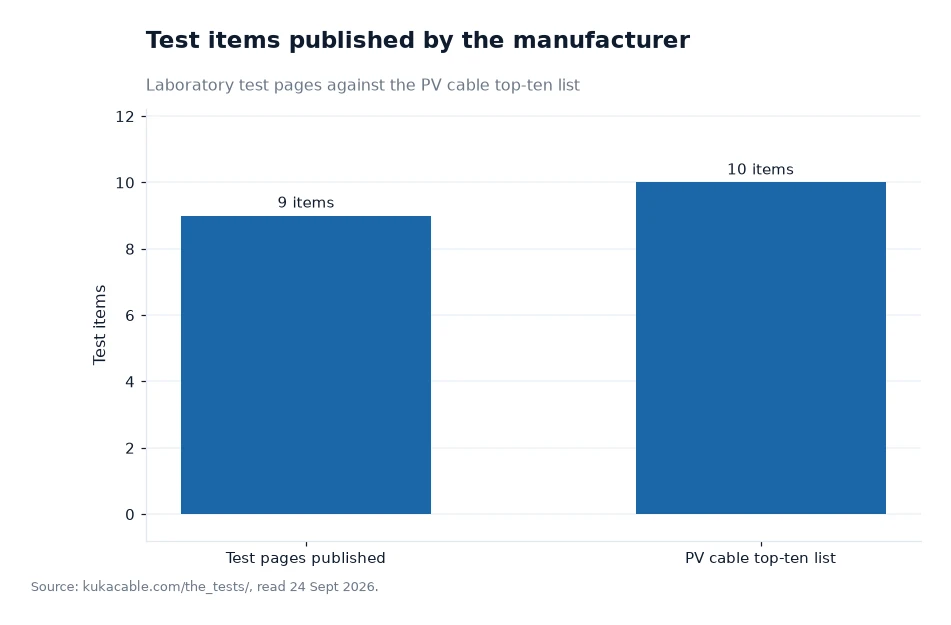
A lighter cable is not a less tested one, and the figures for that come from a different part of the site. KUKA CABLE publishes nine laboratory test write-ups and a numbered list of the top ten tests for PV cables, covering water resistance, UV weather testing, abrasion, cold bending and elongation, tensile strength after ageing, solderability, static flexibility, dimensional checks, conductor and insulation resistance, dielectric strength and flame behaviour. The test pages are worth reading alongside a size table because they describe what every size has to survive before it is wound onto a drum. Certification covering the family is named on the same site and includes TUV, SAA and CPR, which is the set a European rooftop project will usually ask to see.
| Cross-section | Weight per metre | Mass of 250 m | Mass of 1,000 m |
|---|---|---|---|
| 4 mm² | 59 g/m | 14.75 kg | 59 kg |
| 6 mm² | 78 g/m | 19.5 kg | 78 kg |
| 10 mm² | 130 g/m | 32.5 kg | 130 kg |
| 16 mm² | 190 g/m | 47.5 kg | 190 kg |
| 25 mm² | 292 g/m | 73 kg | 292 kg |
Worked example
The chart here belongs to a different question from the one this article asks, so it is presented as the manufacturer's published count of tests rather than as a weight figure. Its own title is "Test items published by the manufacturer", and its two bars are 9 published laboratory test pages and 10 entries in the numbered list for PV cables, taken from kukacable.com/the_tests/. The arithmetic that belongs to this article is weight: dividing 130 g/m by 59 g/m gives 2.20, so a 10 mm² metre weighs 2.2 times a 4 mm² metre, and 250 m of the heavier cable at 32.5 kg is more than twice the 14.75 kg drum. Both calculations are mine, done on published values, and neither changes with the test count.
Frequently asked questions
How much does the cable on a long string actually weigh?
Multiply the published figure by the length. A 200 m string of 4 mm² comes to 11.8 kg, and the same string in 10 mm² reaches 26 kg, both being my own multiplications of 59 g/m and 130 g/m. On a 500 m route the two sizes come to 29.5 kg and 65 kg. Those are cable weights only; clips, ties and trays add more.
Does a lighter cable mean a thinner wall?
No, not across the common sizes. Insulation is published at 0.7 mm and sheath at 0.8 mm for everything from 1.5 mm² to 10 mm², so the weight difference between those sizes comes from the copper, not from the covering. Wall thickness only rises on the larger constructions, where the table shows 0.9 mm to 1.7 mm.
How to choose a size with the weight in view
Start with the electrical requirement, then let handling decide between sizes that both pass. Ask for the drum length, the drum weight and the conductor strand count for the sizes being compared, and check the bending radius against the route before the first clip is fixed. Where the run is long and the roof access is difficult, quoting the published mass per metre in the method statement is a small step that makes the labour plan honest. Technical detail on the range sits on the PV cable pages when the numbers need checking.
Weights, diameters, strand counts and test totals above were read from the manufacturer's own website, kukacable.com, retrieved 24 Sept 2026, and the drum masses and weight ratio are my own arithmetic on those published values[1].